Catch basins, drainage pipe and exfiltration trenches that get rainwater off your property and away from your buildings. Designed around your site, permitted correctly and installed by Flowlex across Broward, Miami-Dade and Palm Beach Counties.
A storm drain system collects rainwater from driveways, parking lots, yards and roofs and carries it away through underground pipe, so water doesn’t pond against buildings or flood the property.
On many South Florida sites the water is sent to a structure that lets it soak back into the ground, or to a public storm sewer, swale, canal or lake where the local permit allows it. Which one your property uses depends on the site and on what the permitting agency approves.
Flowlex installs new systems, extends and repairs existing ones, and clears and replaces damaged structures and pipe.
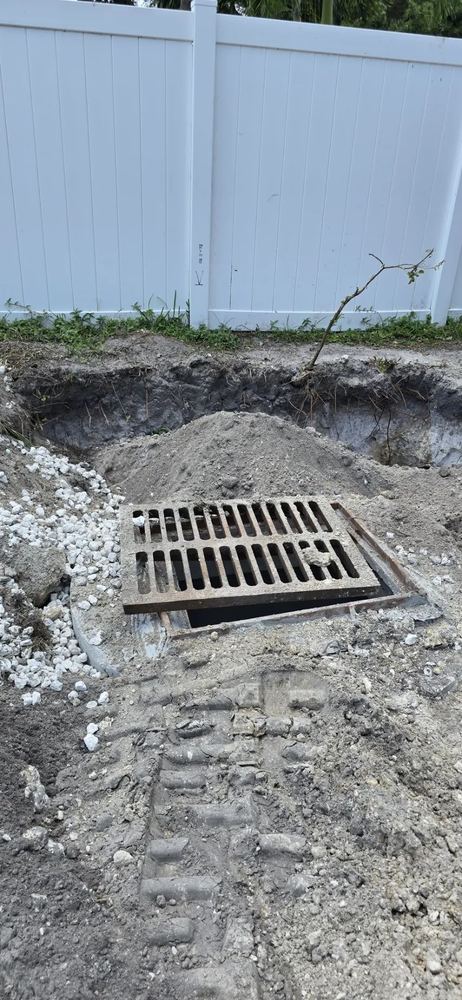
Standing water, flooded driveways and drainage that fails inspection all cost time and money. Flowlex builds storm drainage that is designed around your site, permitted correctly and inspected before it is covered.
Permit applications, submittals and inspections are prepared and coordinated for you, so nothing stalls between offices.
One team, one schedule and one point of contact from the site visit to the final inspection.
Send your plans, survey or city comments one time. We review them and come back with the next steps.
We follow up by phone or email and explain what your city or county requires, in plain English.
Every site is different, but most systems are built from the same pieces.
Concrete boxes with a grate on top. Water drops in through the grate, and the box holds back sand and debris before the water enters the pipe.
Smaller inlets for patios, walkways and driveways, and long slotted drains across a driveway or loading area.
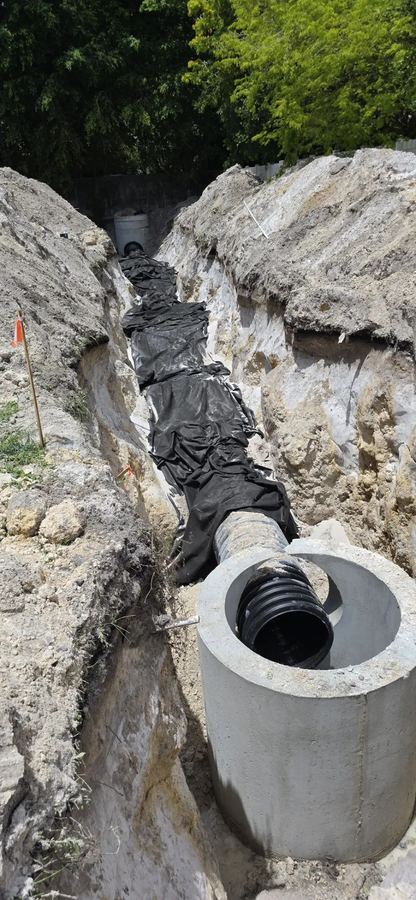
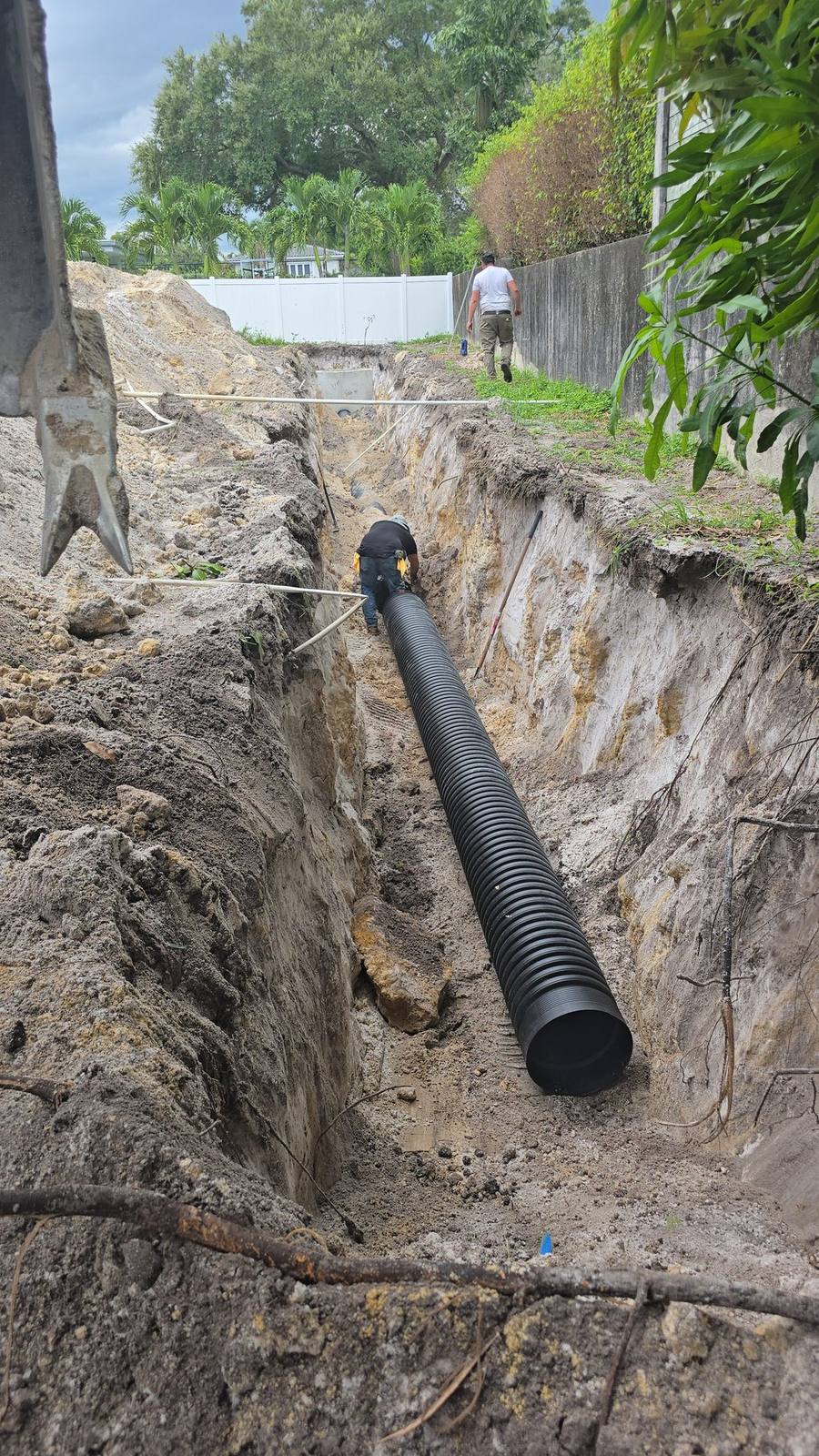
PVC or HDPE pipe that carries the water between structures, laid at a steady slope so it keeps flowing.
Perforated pipe in a gravel-filled trench wrapped in filter fabric, which lets the water soak into the ground along its length.
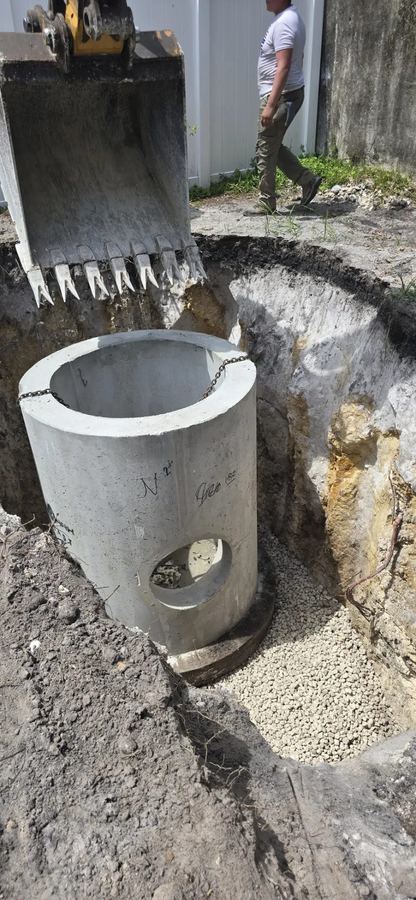
Larger concrete structures where pipes meet or change direction, with a lid for cleaning and inspection.
Where the system ends: a swale, a lake or canal, or a connection to the public storm sewer, as the permit allows.
Drainage is reviewed at more than one level. Which ones apply depends on where the property is and how big the project is.
The city reviews drainage on building, site and right-of-way permits. For example, Pembroke Pines requires an Engineering Division permit for drainage lines, structures and swales, and Fort Lauderdale’s Engineering Permitting Division reviews site plans for stormwater management. Each city page lists what that city publishes.
Source: City of Pembroke Pines: Engineering Permits · City of Fort Lauderdale: Engineering PermitsCounties have their own surface water and environmental programs. In Miami-Dade, a Class II Permit is required for any outfall or overflow that discharges into a water body. Confirm the current requirement with Broward County, including whether your project needs a county approval.
Source: Miami-Dade County: Class II PermitLarger projects need an Environmental Resource Permit. The district regulates residential and commercial developments; small upland projects (under 10 acres, under 2 acres of impervious surface) can use a general permit with an electronic self-certification before construction.
Source: South Florida Water Management District: Environmental Resource PermitsGeneral principles only. The actual design for a site comes from the approved plans and calculations.
More roof and pavement means more water reaching each inlet and pipe at once. Inlets, pipe and structures have to be sized for the area they serve.
Designs are checked against the rainfall the reviewing agency requires. A system that is too small backs up, ponds and overflows in exactly the storms it was meant for.
Exfiltration trenches and retention areas need enough length, volume and distance above the groundwater. With a high water table, the ground can take in less water.
Rain that runs off pavement and roofs picks up what is on them. These are the reasons the state and the water management district give for regulating it.
DEP notes that Florida was the first state in the country to adopt a rule requiring stormwater treatment to a specified level of pollutant load reduction for all new development. The original rule was adopted in 1981 and went into effect in February 1982.
Source: Florida DEP: ERP StormwaterSenate Bill 712, Florida’s Clean Waterways Act, directed DEP to adopt new stormwater rules to support the goal of improving water quality.
Source: Florida DEP: Stormwater Rule Update, May 28, 2024 (PDF)The Legislature ratified the revised rules with amendments under Senate Bill 7040. For all sites, treatment designs must reduce total phosphorus by 80% and total nitrogen by 55% (or keep post-development loads at or below pre-development), with stricter targets for discharges to Outstanding Florida Waters and impaired waters.
Source: Florida DEP: Stormwater Rule Update, May 28, 2024 (PDF)Florida’s Department of Environmental Protection (DEP) explains that stormwater runoff “picks up pollutants like trash, chemicals, and sediment that can harm our rivers, lakes and estuaries.”
Source: Florida DEP: StormwaterThe South Florida Water Management District requires an Environmental Resource Permit for development and construction “to prevent flooding, protect the water quality of Florida’s lakes and streams from stormwater pollution, and protect wetlands and other surface waters.”
Source: South Florida Water Management District: Environmental Resource PermitsPublic storm systems (DEP calls them MS4s) include ditches, curbs, catch basins and underground pipes. Anything entering them that is not stormwater is an illicit discharge, except flows an NPDES permit allows. Miami-Dade County puts it simply: “nothing but rainwater is allowed to drain into the storm drains located in streets, curbs, and right-of-ways.”
Source: Florida DEP: Municipal Separate Storm Sewer Systems (MS4) · Miami-Dade County: Flood PreventionThe water management district notes that when the underground water table is already high, water cannot soak into the saturated ground, and water in streets, swales, yards and low-lying areas after a heavy rain is expected. That is why each system has to be designed for the site it serves.
Source: South Florida Water Management District: Before and After the Storm (PDF)Which permits a drainage job needs depends on the size of the project, the city or county, and where the water goes.
Two ways to handle the permit. We can handle the permit process for you, or, if you prefer to do it yourself, here are the official links. Forms are always filed with the city or county, never through Flowlex.
In South Florida, the water management district regulates residential and commercial developments, roadway construction and agriculture, while DEP oversees single-family home projects, among others. Small upland projects (under 10 acres of total project area and under 2 acres of impervious surface) can use a general permit that requires an electronic self-certification before construction begins.
Source: South Florida Water Management District: Environmental Resource PermitsFlorida’s revised stormwater rules (Chapter 62-330, Florida Administrative Code) took effect on June 28, 2024. Permit applications deemed complete after December 28, 2025 must meet the revised nutrient treatment requirements, and permits issued after June 28, 2024 require a Qualified Inspector for required inspections after June 28, 2025.
Source: Florida DEP: Frequently Asked ERP Stormwater Questions · South Florida Water Management District: Environmental Resource PermitsMiami-Dade requires a Class II Permit to build, install or alter any outfall or overflow system that discharges into a water body in the county. The permit requires treatment of the runoff before it is discharged.
Source: Miami-Dade County: Class II PermitMiami-Dade requires a Class VI Permit for a drainage system on any project with known soil or groundwater contamination, or one that uses, generates, handles or stores hazardous materials.
Source: Miami-Dade County: Class VI PermitFlowlex reviews the permit requirements for your property during the site visit, prepares and submits the applications on your behalf, and schedules the inspections. Permit fees are listed separately in your written price.
Call, send the quote form or message us on WhatsApp with the address and what you’re seeing: standing water, a clogged inlet, a new build.
We look at where water collects, where it can go, the existing structures, access for equipment and any underground utilities.
You get a written scope and price before any work begins. Nothing starts until you accept it.
We apply for the required permits, call in utility locates, then excavate, set structures and lay pipe to grade.
We schedule and attend the inspections, backfill, restore the surface and walk the finished job with you.
Photos from recent Flowlex storm drain installations in South Florida.
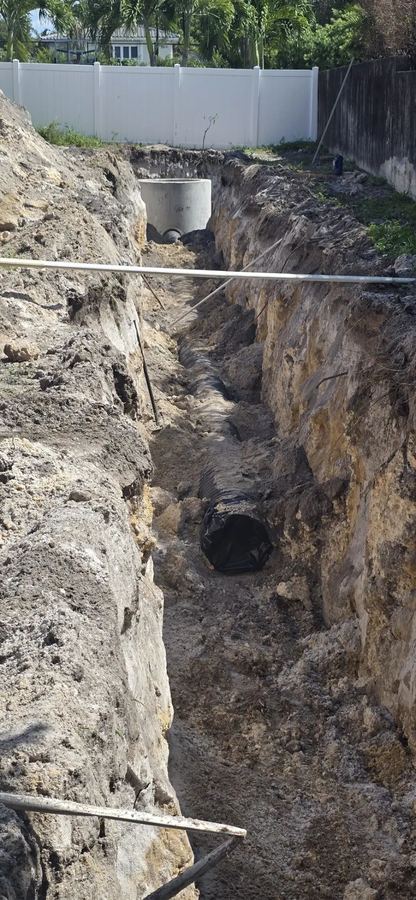
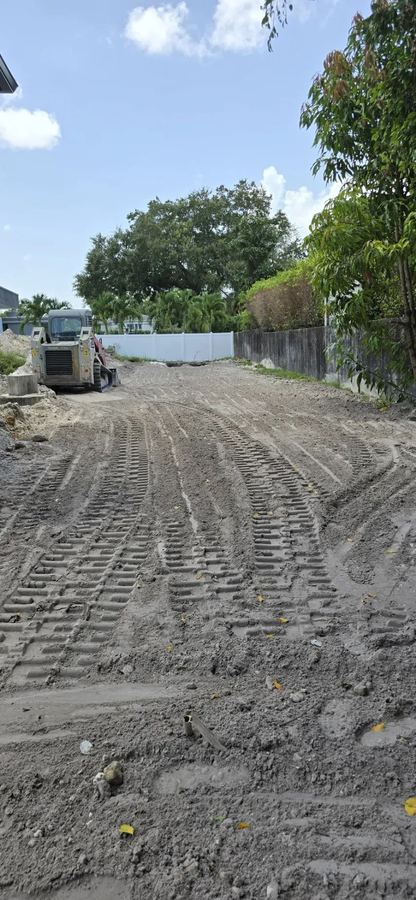
Low spots, clogged or missing inlets, broken pipe and a high water table all cause it. The South Florida Water Management District notes that when the water table is already high, rain can’t soak into the saturated ground (SFWMD). A site visit shows which of these is happening on your property.
Usually, yes, but which permit depends on the size of the project, the city or county, and where the water goes. Larger projects need a state Environmental Resource Permit (SFWMD), and in Miami-Dade an outfall into a water body needs a Class II Permit (Miami-Dade County). We confirm the requirements for your address and handle the applications.
Only stormwater belongs in the public storm system. DEP treats any other discharge as illicit unless a permit allows it (Florida DEP). Miami-Dade allows nothing but rainwater in street storm drains (Miami-Dade County).
It is perforated pipe laid in a gravel-filled trench wrapped in filter fabric. Water enters the pipe at a catch basin and soaks into the ground along the length of the trench.
It depends on the number of structures, the length and depth of pipe, the site and the permits required. After a site visit, you get a written scope and price before any work begins. Estimates are free. Want a price? Contact us: call (754) 444-0650 or upload your plans and request pricing.
It varies with the scope: the size of the area, pipe length and depth, soil and site access, and how long permits and approvals take. You get a schedule with your written scope and price.
Miami-Dade, Broward and Palm Beach Counties and the surrounding areas, extending north to the Orlando area. Call or message us if you are unsure whether we cover your location.
Yes. Flowlex works on homes, commercial properties, parking lots and multi-unit buildings across Broward, Miami-Dade and Palm Beach Counties.
Flowlex installs and repairs storm drain systems for homes, businesses and property managers in these cities and the areas around them.
Cities with a dark outline have their own page with the local requirements and links to the official forms.
Don’t see your city? Call us or send a request, we may still be able to help.
Based at 1416-3 N Dixie Hwy, Hollywood, FL 33020. Serving Miami-Dade, Broward and Palm Beach Counties and the surrounding areas, extending north to the Orlando area. Other services: Septic Tank Systems · Grease Trap Systems · House Sewer Lines.
Every fact on this page comes from these official government pages. Rules change, so the agency’s own page is always the final word.
Want a price? Contact us. Upload your plans or describe the project, and we review it and follow up by phone or email.